

The AI crisis assistant
that doesn’t improvise.
Your people already ask AI for answers. Support your duty of care with approved emergency procedures inside the tools they have open. Returned as written.
Governed, not clever
Most AI answers a question.
This one reads you the procedure.
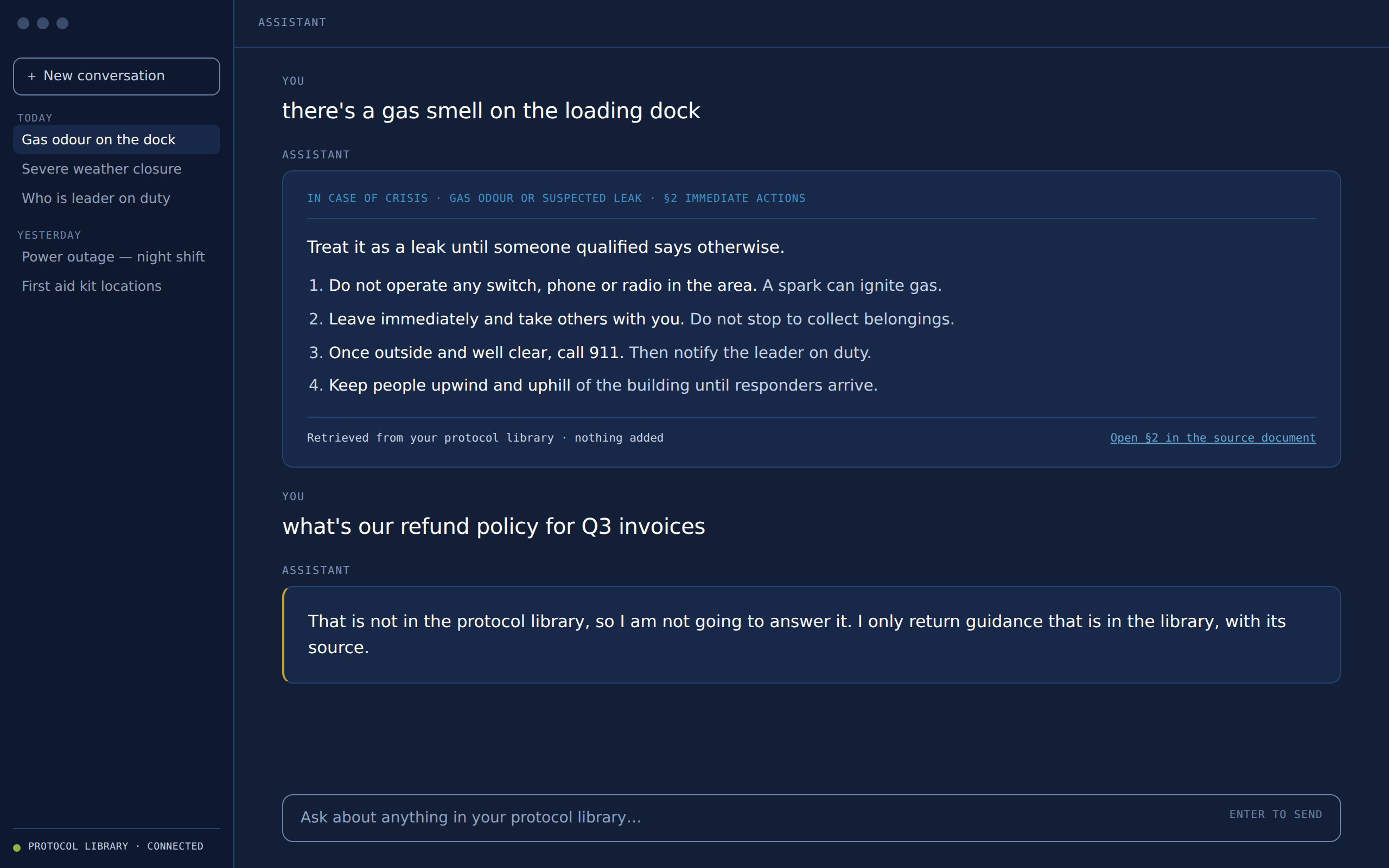
A general-purpose assistant will paraphrase. In an emergency, a paraphrase is a rewrite of a safety instruction by a system nobody reviewed. So we built the server to hand back the approved text exactly as your organization published it, every time, with the source attached.
Twenty seconds.
Exact text
The connector returns the approved procedure verbatim. No summarizing step sits between your published protocol and the person reading it.
Always cited
Every answer names the protocol it came from and when that protocol was last approved. Anyone can check the source in one click.
Silent on what it doesn’t have
Ask about something outside your library and it says so, then points to a human. It does not fill the gap with general knowledge.
What it does
Three jobs, one connector.
Built on the same crisis management practice RockDove has been shipping to enterprises for years. The delivery surface changed. The discipline behind the content didn’t.
Access to reviewed protocols
An employee asks in plain language, in the same AI chat they already use. They get back a protocol from the reviewed base library, returned verbatim and cited to its federal source.
Incident reporting and audit trail
Report an incident from the same conversation. Every report, and every question asked during an event, lands in a record you can produce afterward.
Create customized protocols
Coming soonAdd your own protocols for what’s specific to your sites and people, beyond the base library. Ask about them the same way, in the same AI chat, and get your organization’s own procedure back.
The content
Thirty protocols to start from.
Then the ones only you have.
You don’t begin with an empty library. Every customer starts with a set of workplace emergency protocols built from United States federal-agency guidance, then adds what is specific to their own sites and people.
Source
Built on public authority
Each protocol is written from a named public source: CISA, FEMA and Ready.gov, OSHA, or NIST. Every one carries its citation.
Coverage
Six categories
Fire and life safety. Severe weather and natural hazards. Hazardous materials and utilities. Security and violence. Health and medical. Cybersecurity and information security.
Review
Professionally Reviewed
The library has been reviewed by a certified emergency management professional.
Onboarding is a conversation, not a document dump.
Coming soonUpload your existing plan as a starting document, or work through the setup as a live interview with our team.
We don’t ask you to hand over a binder and hope we parse it. You answer a short structured set of questions about your organization: who does what, where people assemble, who declares an all clear — and you’re set up in minutes. Your protocols get published against those answers, so an employee never reads a reference to a role their company doesn’t have. The protocol text itself is never edited.
Where it runs
No new app for anyone to remember.
Emergency software has one hard problem that has nothing to do with software: the day it matters is the day nobody remembers the login. Our answer is to stop asking. In Case of Crisis AI connects through the Model Context Protocol, the open standard for connecting AI assistants to live systems, so the crisis assistant appears inside the tool your employee already had open.
One connection, scoped by your admin, and your protocols are reachable from the chat window your people use all day.

Connect through the Claude connector directory. Org-wide authentication routes through your admin console and identity provider.

Published to your workspace through your admin’s connector review, the same path your other approved data sources take.

Available through Copilot Studio. Support in the default Copilot chat window depends on your Microsoft licensing.
Boardroom Risk Radar
What’s moving onto the boardroom agenda.
A quarterly index of the risks gaining executive attention. Scored from board and executive commentary, regulatory and legal activity, insurance signals, and real-world incidents. Not a sales pitch: a working tool for your next leadership meeting.
First issue: October 2026
Coming soonEight to twelve risks, each with an attention score, a trend, what changed this quarter, and the questions leaders should be asking. Sources and update date on every entry.
Security and governance
The questions your CISO will ask, answered on this page.
Connecting an AI assistant to an internal system is a security review, not a purchase. Here is our posture, stated plainly enough that you can forward this section instead of scheduling a call.
- No new AI subprocessor
- Inference runs on your existing Claude, ChatGPT, or Copilot subscription, under the enterprise agreement you already have. Adopting In Case of Crisis AI does not introduce a new AI vendor into your data-handling chain.
- Authenticated, permission-scoped
- Connections use standard OAuth against your identity provider. The assistant can reach only what the signed-in employee is already permitted to reach, enforced server-side rather than by prompt.
- Every query logged
- Questions asked and protocols returned are written to the same audit trail as the rest of the platform. After an incident you can show what was asked, what was returned, and when.
- Live retrieval, nothing copied
- Protocols are read from your live library at the moment of the question.
- Card data never touches us
- Payment is handled by Stripe’s hosted checkout. Card details never reach a RockDove server, which is also the answer to the PCI question on your questionnaire.
- Your content does not train models
- Your protocols, incidents, and queries are not used to train third-party AI models.
- Certifications
- RockDove maintains an annual SOC 2 Type II report, audited by Prescient Assurance, most recently for the period ending 1 February 2026. Available through our Trust Center.
Deployment
Your admin decides who turns it on.
Some vendors sell the fact that employees can connect a tool without asking IT. We think that’s backwards for anything touching emergency procedure. The connection is scoped by your administrator, published to the groups you choose, and revocable from the same console.
For the admin, setup is a connector URL and an OAuth authorization. For the employee, there is nothing to install and nothing to remember.
Step one
Publish your library
Answer the onboarding questions. Your protocols are generated, reviewed by your team, and approved.
Step two
Scope the connector
Your admin authorizes the connector and chooses which groups can enable it.
Step three
Tell people it’s there
Then the hard part is done. When someone needs it, they ask the tool already in front of them.
Audit logs
What was asked, and what came back.
Each record includes the question, model, library version, time, user, response, and refusal. Reviewers can see exactly what a record contains.
Log types
- Question captured
- Power outage · building systems unavailable
- Request details recorded
- User, model, and request time
- Protocol-linked
- Power and Utility Outage · scenario draft
- Source attached
- Power Outages · Ready.gov / FEMA
- Outcome recorded
- Response or library-boundary refusal
Subscription Price
Ready to get started?
Seven days, full function, no reduced version. Emergency preparedness is not something you can evaluate from a demo account.
Pre-launch
Organization size
Billing
$400 per month
Billed annually at $4,800/year
For organizations with under 500 employees.
Quoted pricing
Organizations with more than 1,000 employees get a quote from our sales team.
What’s included
- The full protocol library, built from CISA, FEMA and Ready.gov, OSHA, and NIST guidance
- Reviewed by a certified emergency management professional
- Connector for Claude, ChatGPT, and Copilot
- Answers returned as written, with the source cited
- Incident reporting from the same chat
- Audit trail of every question and every protocol returned
- Create customized protocols Coming soon
Pre-launch: requests are taken now and accounts are set up as we open to new organizations.
About Us
We’re not starting an AI company.
This is a new In Case of Crisis service: real access to your approved protocols, right inside the AI chat box your people already use, as a necessary part of your duty of care program. The protocols are delivered where your people are.
Call us at 800-878-1649 or email sales@rockdovesolutions.com.